
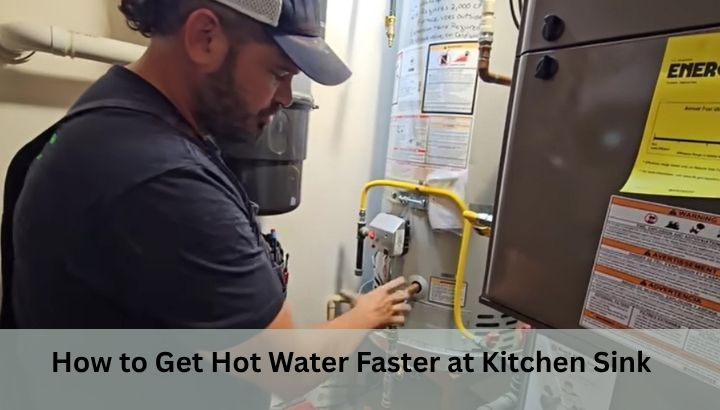
To get hot water faster at your kitchen sink, the most effective solutions are installing a hot water recirculation system, adding an under-sink tankless water heater, insulating your hot water supply pipes, or relocating the water heater closer to the point of use. The right method depends on how far your kitchen sink is from the water heater, your home’s pipe layout, and your budget.
Waiting for hot water at the kitchen sink is one of the most common daily frustrations in residential homes. Every second you run the tap waiting for warm water is water wasted down the drain. The U.S. Department of Energy (DOE) estimates that the average household wastes 10,000 to 15,000 gallons of water per year simply waiting for hot water to arrive at fixtures.
Beyond the waste, that wait time is also a genuine inconvenience when you need hot water for cooking, rinsing dishes, or hand washing quickly.
The good news is that several well-proven solutions can reduce or eliminate the wait entirely, and they range from simple pipe insulation costing under $30 to a full recirculation system installed for a few hundred dollars.
Why Hot Water Takes So Long to Reach the Kitchen Sink
Before choosing a solution, it is important to understand exactly why hot water delivery is slow in the first place. The delay is not caused by the water heater failing to heat water quickly.
In almost every case, the water in the heater is already at the set temperature of 120 degrees Fahrenheit (the recommended setting by the American Society of Sanitary Engineering and the U.S. Environmental Protection Agency for scalding prevention and Legionella pneumophila control) or higher. The problem is purely a distance and delivery problem.
The Cold Water Column in Supply Pipes
Every hot water supply pipe in a home holds a volume of water at all times. When you last used the hot tap, the water that was in the pipe at the time of shutoff gradually cooled down to ambient room temperature.
The next time you open the hot tap, that entire column of cold water must be pushed out of the pipe and down the drain before the heated water from the water heater can travel through the pipe and reach the faucet.
The volume of water in the pipe depends on two variables: pipe diameter and pipe length. A standard 1/2-inch nominal copper pipe holds approximately 0.010 gallons per foot of length. A 3/4-inch copper pipe holds about 0.023 gallons per foot.
In a home where the water heater is located in a basement or utility room 40 to 60 feet of pipe away from the kitchen sink, the hot water supply line may contain a half-gallon or more of cold water that must be purged before hot water arrives. At a typical flow rate of 1.5 to 2.0 GPM, this takes anywhere from 20 seconds to over a minute.
Pipe Material and Heat Loss
Copper pipe is an excellent conductor of heat, which means it warms up quickly when hot water flows through it but also loses heat rapidly when no water is flowing. CPVC (chlorinated polyvinyl chloride) and PEX (cross-linked polyethylene) tubing are better thermal insulators and retain residual heat longer between uses, meaning the water inside them stays warmer for a longer period after the tap is turned off. In homes with copper pipe runs and no insulation on the hot supply lines, the water in the pipes cools to room temperature faster, increasing the wait time between uses.
Water Heater Location and Distance
The single biggest factor determining hot water delivery time is the linear distance between the water heater and the kitchen sink faucet. A kitchen sink located directly adjacent to a utility closet with the water heater takes only seconds to receive hot water. A kitchen on the opposite end of a large home, or on a different floor from the water heater, may require purging 50 to 100 feet of supply pipe before hot water arrives.
In homes built with a trunk-and-branch plumbing layout, all fixtures share a single main hot water supply line (the trunk) from which smaller branch lines run to individual fixtures.
Fixtures at the far end of the trunk receive hot water last. In homes built with a home-run manifold system using PEX tubing, individual supply lines run directly from a central manifold to each fixture, which can reduce wait times by eliminating shared trunk pressure drops but does not inherently speed up hot water delivery unless the manifold is close to the fixtures.
Solutions to Get Hot Water Faster at the Kitchen Sink
Install a Hot Water Recirculation System
A hot water recirculation system (also called a hot water circulation pump or recirculating pump system) is the most comprehensive solution available for getting hot water faster at every fixture in the home, including the kitchen sink. It works by keeping hot water continuously circulating through the supply pipes so that hot water is available at the tap almost instantly, without purging a column of cold water first.
A dedicated return line recirculation system installs a circulating pump at the water heater and runs a separate return pipe from the furthest fixture in the home back to the heater inlet. Hot water is kept moving in a continuous loop. When any tap is opened, hot water arrives within seconds because the supply pipe already contains hot water at or near the set temperature.
The comfort series recirculation system or crossover valve system (also called a no-return-line recirculation system) is a retrofit option for homes that do not have a dedicated return pipe. A thermostatic bypass valve installs under the furthest sink from the water heater, connecting the hot and cold supply lines.
A small pump pushes water from the hot supply through the bypass valve and into the cold supply line back to the heater. This method brings hot water to all fixtures quickly without any new return pipe, making it the preferred retrofit solution for existing homes.
Leading manufacturers of hot water recirculation systems include Grundfos (the Comfort Series pump), Watts Water Technologies (the Watts Premier series), Taco Comfort Solutions, Rinnai (for use with Rinnai tankless heaters), and Eemax.
Most residential recirculation pumps draw between 25 and 85 watts of electricity and can be programmed with a built-in timer or connected to a demand-activated push-button sensor so the pump only runs when needed, minimizing energy use.
Key advantage: Hot water reaches the kitchen sink in 2 to 5 seconds from any distance. Primary cost: $200 to $600 installed for a pump with timer or demand control; more for full dedicated return line systems.
Install an Under-Sink Tankless Water Heater
A point-of-use tankless water heater (also called an on-demand water heater or instantaneous water heater) installs directly under the kitchen sink cabinet and heats water on demand as it flows through the unit. Because the heater is located at the point of use, the hot water supply pipe between the heater and the faucet is only inches long, eliminating the wait time completely regardless of where the central water heater is located.
Under-sink tankless units for kitchen applications are typically electric rather than gas, because running a gas line under a sink cabinet is impractical in most homes. They connect to the existing cold water supply line under the sink and deliver heated water to the kitchen faucet independently of the central water heating system.
Popular electric point-of-use tankless water heater brands and models include the Bosch Tronic 3000 series, Stiebel Eltron Mini series, EcoSmart ECO 11 (though this is larger), Rheem RTEX-04 and RTEX-06 small point-of-use units, and the Chronomite Instant-Flow series. These units typically require a 120V or 240V dedicated electrical circuit and draw between 1.5 kW and 6 kW depending on the flow rate and temperature rise required.
One practical consideration: a point-of-use unit installed under the kitchen sink does not solve slow hot water delivery at other fixtures. It is a localized solution that works best when the kitchen is the primary location where faster hot water is needed.
Key advantage: Eliminates wait time entirely at the kitchen sink without affecting the rest of the home’s plumbing. Primary cost: $150 to $400 for the unit plus installation.
Insulate the Hot Water Supply Pipes
Pipe insulation is the lowest-cost intervention that improves hot water delivery speed. It does not actively deliver hot water faster in the way a recirculation pump does, but it significantly reduces the rate at which water in the hot supply pipes cools between uses. The warmer the water sitting in the pipe when you turn on the tap, the less cold water must be purged before hot water arrives.
Foam pipe insulation sleeves made from polyethylene foam or neoprene rubber are the standard materials for hot water pipe insulation in residential applications. They are sold by brands including Frost King, Armacell, Thermacell, and available at hardware stores under store brands. They slip directly over exposed pipe runs and are secured with foil tape or adhesive seams. They are available in sizes to fit 1/2-inch, 3/4-inch, and 1-inch nominal pipe in standard six-foot lengths.
For pipes inside walls, insulation cannot be added without opening the wall surface. In this case, combining pipe insulation on all accessible sections with another solution such as a recirculation pump produces the best results.
Key advantage: Reduces heat loss in pipes between uses, decreasing wait time gradually. Primary cost: $20 to $60 for materials covering a typical home’s exposed pipe runs.
Install a Small Point-of-Use Tank Water Heater
A mini tank water heater (also called a point-of-use storage water heater) stores a small volume of pre-heated water, typically 2.5 gallons to 10 gallons, directly under the kitchen sink. Because it holds a reserve of hot water at the point of use, hot water is available immediately when the tap is opened without waiting for water to travel from the central heater.
Popular mini tank water heater models include the Bosch Electric Mini-Tank Water Heater Tronic 3000 T 2.5-Gallon, the Ariston GL4S, the Eccotemp EM-7.0 mini tank, and the A.O. Smith ESST-52 Point-of-Use Electric Water Heater. These units connect to the cold supply line under the sink and output to the hot side of the faucet. They operate on standard 120V household current and have a relatively low operating cost because they are only heating a small volume of water.
The limitation of a mini tank heater is recovery time. Once the stored hot water is depleted by extended use, the tank must reheat before delivering hot water again, which takes approximately 20 to 30 minutes for a 4-gallon unit. For the typical kitchen sink usage pattern of short bursts of hot water for rinsing and washing, the stored volume is usually more than sufficient.
Key advantage: Eliminates wait time at low upfront cost with no special electrical circuit needed for smaller models. Primary cost: $100 to $250 for the unit.
Upgrade to a Tankless Water Heater Closer to the Kitchen
If the central water heater is located far from the kitchen and is due for replacement, upgrading to a tankless water heater (also called an on-demand water heater) positioned closer to the kitchen can reduce wait times significantly. Unlike a traditional tank-style water heater that stores water and keeps it heated continuously, a condensing tankless water heater or non-condensing tankless water heater heats water only when a tap is opened, delivering a continuous flow of hot water without a storage tank.
Major gas tankless water heater brands include Rinnai, Navien, Noritz, Takagi, Rheem, Bradford White, and A.O. Smith. Electric tankless water heaters include models from Stiebel Eltron, EcoSmart, Eemax, and Bosch. Positioning the unit in or near the kitchen utility space or under a counter reduces the pipe run significantly.
Combined with a recirculation kit that many modern tankless units support natively (Rinnai’s RUR series and Navien’s NPE-A2 series have integrated recirculation pumps), a well-positioned tankless heater can deliver near-instant hot water at the kitchen sink and throughout the home simultaneously.
Key advantage: Eliminates storage heat loss, provides unlimited hot water, and reduces delivery time when positioned strategically. Primary cost: $800 to $2,500 installed depending on unit size and fuel type.
Use a Demand-Controlled Hot Water Recirculation Button
For homeowners who want the benefits of faster hot water without running a pump continuously, a demand-controlled recirculation system provides the best balance of speed and energy efficiency. A push-button or motion-activated sensor mounts near the kitchen sink. When pressed or triggered, it activates the recirculation pump, which pushes hot water from the heater through the supply line to the sink. By the time you have rinsed your hands or turned to the sink, hot water is already present at the tap.
The Grundfos Comfort PM Auto Adapt and the Watts Premier instant hot water recirculating system with push-button or timer control are among the most widely used demand-controlled options. These systems consume minimal energy because the pump only runs when activated, and the hot water diverted during the pre-circulation cycle enters the cold supply line rather than running down the drain.
Step-by-Step Guide to Installing a Recirculation Pump Under the Sink
Step 1: Confirm Your System Type and Measure the Pipe Run
Before purchasing a pump, determine whether your home has a dedicated hot water return line running back to the water heater. Most homes built before 2000 do not have a return line. If there is no return line, a comfort or crossover valve system is the correct choice. Measure the approximate pipe distance between your kitchen sink and the water heater to confirm the pump model’s rated capacity is sufficient.
Step 2: Turn Off the Water Supply
Shut off the cold water supply valve under the sink. Open both the hot and cold taps at the sink to release residual pressure in the supply lines.
Step 3: Install the Thermostatic Bypass Valve Under the Sink
The thermostatic bypass valve connects between the hot and cold supply lines under the kitchen sink at the inlet connections to the faucet. Use 3/8-inch compression fittings or the supplied adapters to connect the valve between the hot and cold supply tubes. The valve opens automatically when the water in the hot supply line drops below a preset temperature (typically 95 to 98 degrees Fahrenheit) and closes when hot water arrives.
Step 4: Install the Circulating Pump at the Water Heater
At the water heater, install the circulating pump on the outlet (hot water output) side of the heater using the supplied fittings. Connect the pump’s power cord to a nearby 120V outlet or connect to a switched circuit if using a timer control.
Step 5: Set the Timer or Demand Control
Program the pump’s built-in timer to run during the hours when hot water is needed most, typically morning and evening. Alternatively, connect a push-button demand sensor at the kitchen sink location and wire it to the pump control for on-demand activation only.
Step 6: Restore Water Supply and Test
Turn the cold water supply back on. Open the hot tap at the kitchen sink and run it for 30 seconds to purge air from the system. Activate the pump using the timer or button and measure how quickly hot water arrives at the tap. A correctly installed system should deliver hot water to the kitchen sink in 5 to 15 seconds regardless of pipe distance.
Comparison Table: Methods to Get Hot Water Faster at Kitchen Sink
| Method | Wait Time Reduction | Affects Other Fixtures | Water Savings | Approx Cost | DIY Friendly |
|---|---|---|---|---|---|
| Hot water recirculation pump (dedicated return line) | Nearly instant | Yes, all fixtures | High | $400 to $800 installed | Moderate |
| Crossover valve recirculation (no return line) | 5 to 15 seconds | Yes, along pipe run | High | $200 to $500 installed | Moderate |
| Point-of-use tankless heater under sink | Instant | No, kitchen only | High | $150 to $400 | Moderate |
| Mini tank point-of-use water heater | Instant | No, kitchen only | High | $100 to $250 | Easy |
| Pipe insulation on supply lines | Partial (reduces cooling) | Yes, modest improvement | Moderate | $20 to $60 | Very Easy |
| Demand-controlled push-button pump | 5 to 20 seconds | Yes, along pipe run | Very High | $150 to $350 | Moderate |
| Tankless heater repositioned near kitchen | 5 to 20 seconds | Yes, nearby fixtures | High | $800 to $2,500 | Professional |
| Water heater temperature increase | Minor improvement | Yes, all fixtures | Low | $0 (adjustment only) | Very Easy |
Benefits of Getting Hot Water Faster at the Kitchen Sink
Getting hot water faster at the kitchen sink has measurable benefits that extend beyond simple convenience. Water conservation is among the most significant. The gallons of cold water purged from the supply pipe every time you run the hot tap all flow into the drain unused. A household that uses the kitchen hot tap an average of 10 times per day and waits 30 seconds each time at a flow rate of 1.5 GPM is sending approximately 75 gallons per week directly down the drain. Over a year, this is close to 3,900 gallons of treated municipal water wasted entirely.
From an energy efficiency standpoint, faster hot water delivery also means the water heater maintains its set temperature with fewer reheating cycles, since less cold water enters the tank due to shortened draw periods. WaterSense, the EPA’s water efficiency certification program, recognizes hot water distribution efficiency as a component of sustainable home plumbing design.
In practical kitchen use, faster hot water improves food preparation workflows. Tasks such as blanching vegetables, rinsing produce under warm water, or quickly washing hands between food preparation steps all benefit from immediate hot water availability. In commercial kitchens, NSF International and the Food and Drug Administration (FDA) Food Code require hand-washing stations to deliver water at a minimum of 100 degrees Fahrenheit promptly, reflecting the recognized hygiene importance of accessible hot water.
Common Mistakes Homeowners Make When Trying to Get Hot Water Faster
Increasing the Water Heater Temperature Too High
A common first attempt to get faster hot water is turning up the water heater thermostat to a higher setting, reasoning that hotter water will be more detectable sooner as it travels through the pipe. This logic has a small basis in reality but at a significant cost. Setting a gas water heater or electric water heater above 120 to 125 degrees Fahrenheit creates a serious scalding risk, especially for children and elderly residents. It also significantly increases standby heat loss from the tank and raises energy bills. The U.S. Consumer Product Safety Commission (CPSC) recommends 120 degrees Fahrenheit as the maximum residential setting. A temperature increase does not solve the root cause and should not be relied on as a delivery speed solution.
Running the Hot Tap to Pre-Warm Before Needed
Some households leave the hot tap running at a trickle before they need hot water, thinking this warms the pipe proactively. This wastes water continuously and provides no meaningful benefit compared to the targeted solutions described above. It also causes unnecessary wear on the faucet’s ceramic disc cartridge or ball valve assembly from prolonged partial-open operation.
Installing a Recirculation Pump Without a Timer or Demand Control
A recirculation pump that runs 24 hours a day keeps hot water circulating continuously, which maximizes delivery speed but does so at a significant energy cost. The pump itself draws 25 to 85 watts continuously, and the constant circulation causes the water heater to fire more frequently to replace heat lost to the pipe system. Without a programmable timer or push-button demand control, the energy savings that justify a recirculation system are greatly reduced. Always program or control pump operation to align with actual household usage patterns.
Choosing the Wrong Size Point-of-Use Heater
A point-of-use tankless heater that is undersized for the kitchen faucet’s flow rate and the temperature rise required will not deliver adequately hot water. Temperature rise is the difference between the incoming cold water temperature and the target output temperature. In northern climates where incoming cold water may be 45 to 55 degrees Fahrenheit in winter, achieving a 120-degree output requires a larger heater than in southern climates where incoming water may be 65 to 75 degrees Fahrenheit. Always calculate the required kilowatt rating based on your local cold water temperature and desired output before purchasing a point-of-use unit.
Neglecting to Insulate Accessible Pipe Sections After Installing a Recirculation Pump
Installing a recirculation pump and then leaving all supply pipes bare and uninsulated forces the pump to work harder and cycle more frequently because uninsulated pipes lose heat faster. Combining a recirculation system with pipe insulation on all accessible runs in the basement, crawl space, or utility area produces the best overall performance and the lowest ongoing energy cost.
Frequently Asked Questions
Why does it take so long to get hot water faster at my kitchen sink even though the water heater is working fine?
The delay in getting hot water faster at your kitchen sink has nothing to do with your water heater’s performance. The heater has already heated the water to the set temperature. The wait time is caused by the volume of cooled water sitting inside the hot water supply pipe between the heater and the sink. Every time you use the hot tap, hot water from the heater pushes out this column of cooled water first before reaching your faucet. The longer and wider the pipe run, the more cold water must be purged before hot water arrives.
What is the cheapest way to get hot water faster at the kitchen sink?
The cheapest way to get hot water faster at your kitchen sink is to install foam pipe insulation on all accessible sections of the hot water supply line running between the water heater and the kitchen. Insulation costs $20 to $60 for materials and does not require any plumbing work.
It reduces the rate at which water in the hot supply pipe cools between uses, meaning the water sitting in the pipe is closer to hot temperature when you turn the tap, resulting in a shorter wait. For zero-wait hot water, a mini tank point-of-use water heater installed under the sink for $100 to $250 is the next most affordable option.
Is a recirculation pump the best way to get hot water faster at the kitchen sink throughout the whole house?
A hot water recirculation pump is the best solution when the goal is faster hot water delivery at the kitchen sink and all other fixtures in the home simultaneously. By keeping hot water pre-staged in the supply lines, a recirculation system with a demand-controlled push-button or a programmable timer delivers hot water to any tap within seconds.
For homes without a dedicated return line, a crossover valve recirculation system achieves the same result without requiring new pipe installation. It is more expensive than localized solutions but provides the broadest benefit and the highest water savings.
Can I get hot water faster at my kitchen sink without any plumbing work?
Getting hot water significantly faster at your kitchen sink without any plumbing modifications is limited in scope, but pipe insulation on exposed supply lines is one option that requires no plumbing connections. You can also adjust your usage habits, such as activating the hot tap 30 seconds before you need hot water to pre-purge the cold column. However, these approaches are not genuine solutions. A plug-in mini tank water heater installed under the sink involves only connecting to existing supply valves and a standard electrical outlet, making it the closest thing to a no-plumbing-work solution that actually works reliably.
Does a tankless water heater help you get hot water faster at the kitchen sink?
A tankless water heater heats water on demand rather than storing it, but it does not inherently deliver hot water faster at the kitchen sink unless it is installed close to the sink or paired with a recirculation system. The delay in getting hot water at the tap comes from the distance between the heater and the faucet, not from how the heater produces the hot water.
A tankless unit installed far from the kitchen will still require purging the cold water in the supply pipe before hot water arrives. Tankless units with built-in recirculation pumps, such as the Rinnai RUR series and Navien NPE-A2, solve this by keeping the pipe pre-loaded with hot water.
Will insulating my pipes help me get hot water faster at my kitchen sink?
Yes, insulating your hot water supply pipes is a genuine improvement that helps you get hot water faster at your kitchen sink by slowing the rate at which the water in the pipe loses heat between uses.
If your kitchen sink is used frequently throughout the day, foam polyethylene pipe insulation or neoprene insulation sleeves keep the water in the supply line warmer between each use, reducing the amount of cold water that must be purged before hot water arrives at the next use.
The improvement is most noticeable when the sink is used in short intervals rather than after long idle periods such as overnight. Insulation is most effective when combined with another solution such as a demand-controlled recirculation pump.
How do I get hot water faster at my kitchen sink in an apartment where I cannot modify the plumbing?
To get hot water faster at your kitchen sink in an apartment where structural plumbing modifications are not permitted, the best option is a plug-in mini tank electric water heater such as the Bosch Tronic 3000 T or Ariston GL4S, which connects to the existing supply valves under the sink and a standard 120V outlet.
These units require no permanent plumbing changes beyond connecting to the existing shut-off valve connections and can be removed when you move. A demand-controlled crossover recirculation valve is another option if your landlord permits it, as the installation is minimal and reversible. Always confirm with your building management before making any under-sink changes.
How long does it typically take to get hot water faster at the kitchen sink after installing a recirculation system?
After a recirculation system is installed and the pump is activated, hot water typically arrives at the kitchen sink within 5 to 20 seconds, depending on the length of the pipe run and the pump’s flow rate. In a home with a pipe run of 30 to 50 feet from the water heater to the kitchen, arrival time is typically under 10 seconds.
In very large homes with pipe runs exceeding 80 feet, arrival time may be 15 to 20 seconds. In all cases, this is dramatically faster than the 45 to 90 seconds of wait time that would otherwise be required to purge a long cold water column. With a point-of-use tankless heater or mini tank installed directly under the sink, hot water arrives in 1 to 3 seconds regardless of the home’s pipe layout.
Conclusion
Getting hot water faster at the kitchen sink comes down to one fundamental issue: reducing or eliminating the cold water column that sits in the supply pipe between the water heater and the faucet. The right solution depends on your specific home layout, budget, and whether you want to improve just the kitchen or every fixture simultaneously.
Pipe insulation is the simplest and cheapest starting point. A mini tank water heater or point-of-use tankless unit installed under the sink provides immediate results at the kitchen specifically.
A hot water recirculation pump with demand control or a timer is the most comprehensive whole-home solution and delivers the best long-term return through water savings and convenience. Pairing any active solution with pipe insulation on accessible runs maximizes performance and minimizes ongoing energy cost.